Glenfiddich: How a Family Dream in a Scottish Valley Became a Global Whisky Legacy
…Some whisky brands are remembered for their age statements, some for their taste and others for their price. Glenfiddich belongs to a smaller group of brands whose identity is almost impossible to separate from the story behind the bottle.
The stag, the unusual triangular bottle, the Scottish landscape and the Glenfiddich name have become familiar symbols in the world of single malt Scotch whisky. Yet behind them is a remarkably human story: one man’s ambition, a family that helped him build a distillery, generations that refused to abandon that dream, and a bold decision to introduce single malt Scotch to consumers around the world.
The story begins with William Grant. After spending roughly two decades working in the whisky industry, including at Mortlach Distillery in Dufftown, Grant decided that working for someone else was no longer enough. He wanted a distillery of his own and, more importantly, wanted to make what he described as the best dram in the valley. In 1886, he and his family began building their distillery in Dufftown, in Scotland’s Speyside region.
This was not a grand industrial project backed by an army of contractors. Grant’s nine children were involved in building the distillery, brick by brick. About a year later, on Christmas Day in 1887, spirit flowed from the Glenfiddich stills for the first time.
Even the name carried a connection to the place where the whisky was born. Glenfiddich is commonly translated as “Valley of the Deer,” drawing on the valley and the River Fiddich that runs through the area. That geographical identity would eventually give the brand one of its most valuable assets: the stag. It was not an animal chosen simply because it looked majestic on a whisky bottle. The deer was already part of the meaning and identity of Glenfiddich itself.
The name, the valley and the animal belonged to the same story.
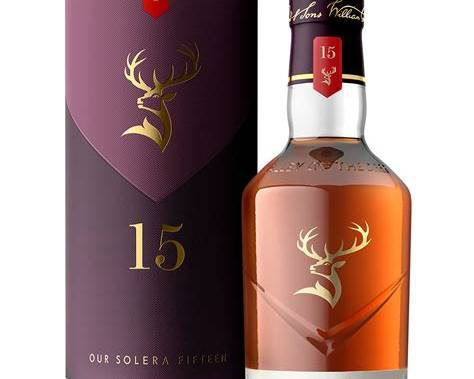
The stag eventually became one of the most recognisable features of Glenfiddich’s visual identity. The brand says the stag used on its bottles was originally inspired by Sir Edwin Landseer’s famous 1851 painting, The Monarch of the Glen. By the 1960s, the stag was appearing on Glenfiddich bottles at precisely the moment when the company was beginning one of the most important chapters in its history. It came to communicate something bigger than the animal itself: Scotland, heritage and the sense of independence that Glenfiddich increasingly wanted associated with its name.
In some international markets, the symbol acquired additional meanings. In China and Taiwan, for example, the deer has cultural associations with long life and prosperity, allowing a distinctly Scottish symbol to find another layer of relevance thousands of miles from its place of origin. Then there is the bottle. Long before distinctive packaging became a standard part of modern brand strategy, Glenfiddich understood the advantage of being recognisable before a consumer had even read the label.
Its triangular bottle emerged as an important part of the brand’s identity in the 1950s, with designer Hans Schleger associated with its development. On a shelf filled with conventional bottles, the shape gave Glenfiddich something enormously valuable: a silhouette of its own. Over time, the triangle, the stag, the name and the family’s Scottish heritage came together to form a visual language that could travel across markets and generations.
What makes that heritage particularly compelling is that Glenfiddich did not simply inherit the name of its founder and turn it into an advertising story decades later. The business remains part of William Grant & Sons and has continued under family ownership through generations. In an industry where famous brands have repeatedly changed corporate ownership, that continuity has given Glenfiddich a credible foundation for talking about independence, patience and long-term thinking.
The family’s ambition was never confined to Scotland. Charles Gordon, William Grant’s son-in-law, became an important salesman for the business and travelled internationally in the early twentieth century as the company sought markets abroad. That willingness to look beyond Scotland would later prove decisive. Glenfiddich survived difficult periods for the whisky industry, including wars, economic disruption and American Prohibition, and continued to preserve the production knowledge and infrastructure that would eventually support its international growth. But the turning point came in the 1960s. At the time, international whisky drinkers were much more familiar with blended Scotch. Single malt was nowhere near the globally recognised category it is today.

Glenfiddich’s family leadership saw an opportunity. Instead of treating its malt primarily within the established blending tradition, the company began promoting Glenfiddich internationally as a distinctive whisky in its own right. Sandy and Charles Grant Gordon took the brand into markets including the United States, Europe and Africa, supported by advertising and that unmistakable triangular bottle. Glenfiddich was therefore doing more than selling another Scotch whisky. It was helping introduce international consumers to single malt as a category worth understanding and enjoying on its own terms.
READ MORE: SHORE Lagos by Sailors Unveils New Vision for Premium Waterfront Hospitality in Africa
The liquid, however, still had to justify the story around it. Glenfiddich’s production remains closely associated with Dufftown and the Speyside environment, including water from the Robbie Dhu spring. Traditional skills have also remained important at the distillery, including the work of coppersmiths maintaining the stills and coopers working with the casks in which the whisky matures.
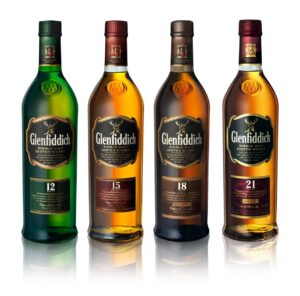
These details matter because whisky does not acquire all its character at the moment of distillation. Time in wood influences its aroma, colour, flavour and complexity, and Glenfiddich has increasingly used maturation and different cask treatments as part of both its whisky-making and its product storytelling. For many drinkers, that journey begins with Glenfiddich 12 Year Old, one of the brand’s most familiar expressions. The 15 Year Old takes the story in a different direction through its Solera Vat process, bringing together whisky matured in different casks, including Spanish sherry and American bourbon casks.
The 18 Year Old moves further into mature expressions, while older releases extend the brand into increasingly premium territory. Glenfiddich’s range has grown to include expressions such as the 21 Year Old Gran Reserva, 23 Year Old Grand Cru and 26 Year Old Grande Couronne, alongside other rare and limited releases.Perhaps the more interesting story, however, is how Glenfiddich has managed to make all these different whiskies feel as though they belong to the same family. Its luxury positioning has never depended entirely on putting an older whisky into a more expensive bottle.
It has been built around a collection of details that reinforce one another: a Scottish valley, a founder with a dream, children helping their father build a distillery, a Christmas Day beginning, a Gaelic name, a stag, a triangular bottle, generations of family ownership, traditional craftsmanship and a willingness to experiment. Individually, each element is interesting. Together, they create something much harder for another brand to copy: a coherent history.
That explains why the stag has become so valuable. It is more than a logo printed on a label. It connects the whisky to its name, its landscape and its Scottish origins. It also provides immediate recognition. A consumer does not need to know every detail of William Grant’s life to understand that the stag belongs to Glenfiddich. In branding terms, it has become a piece of memory.
Glenfiddich has also shown that respecting history does not mean refusing to change. In February 2026, William Grant & Sons announced a refreshed visual identity for the brand. The redesign drew inspiration from Glenfiddich’s archives and elements of its 1960s identity while giving the presentation a more contemporary character. The stag remained central, the wordmark was refreshed, the founding year 1887 received greater emphasis and the Grant Family Crest became more prominent. So too did the family motto, “Stand Fast.” It is an appropriate phrase for a business whose history has depended as much on endurance as expansion.
There is a broader lesson here for anyone interested in brands. A logo by itself does not create heritage. Neither does an expensive package or a clever advertising line. Glenfiddich’s identity works because its different parts support one another. The stag has meaning because it is connected to the name. The name has meaning because it is connected to the place. The triangular bottle works because it creates recognition. The family story matters because family ownership continued. And the premium positioning carries weight because there are whiskies, craftsmanship and experiences behind it.
More than a century has passed since William Grant and his family began building that distillery in Dufftown. What started as one man’s desire to make the best dram in his valley became an internationally recognised single malt Scotch whisky brand. The first spirit flowed on Christmas Day 1887. The valley gave the whisky its name. The deer gave it a symbol. The triangular bottle gave it a distinctive shape. The family took it beyond Scotland, and successive generations continued to combine tradition with experimentation.
Perhaps that is why the Glenfiddich story continues to resonate. The brand has changed bottles, expanded markets, introduced new expressions and modernised its identity, but the heart of its story remains surprisingly simple. A family built something in a Scottish valley. They named it after the place they called home, created a symbol people could remember and eventually took their whisky around the world without completely letting go of where the journey began. More than 130 years later, the stag still stands on the bottle, carrying that story forward.